
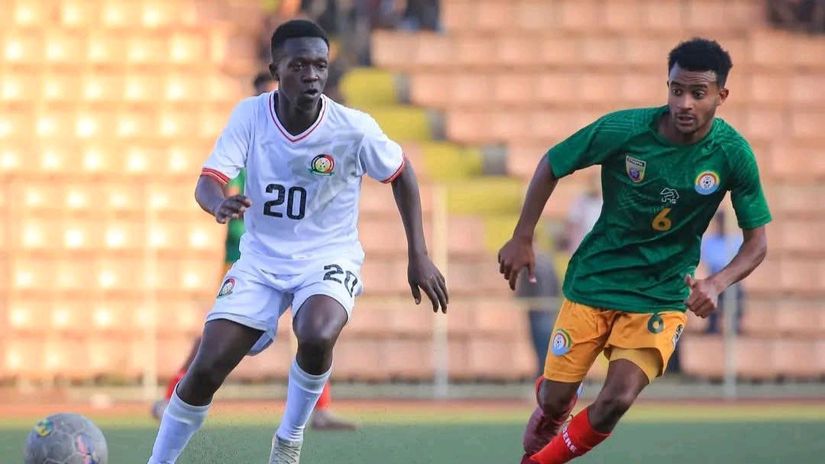
In Addis Ababa, on the artificial turf of Abebe Bikila Stadium, a new Kenyan generation has been learning what it really means to fight for a continental ticket. The **U-17 AFCON qualifiers** in the CECAFA zone have turned the Junior Stars’ campaign into a story of early jitters, brave comebacks and a painful lesson against the hosts that still left the dream of Morocco very much alive.
Slow start against Somalia sets the tone for a gritty campaign
The journey began with nerves. Kenya’s U-17 boys, the Junior Stars, opened their Group A campaign against Somalia, a side that already had a game in their legs after a 2-2 draw with South Sudan. That extra sharpness showed in the opening minutes, as Somalia came out with greater urgency and rhythm, forcing Kenya to adjust quickly.
In the 8th minute, the Kenyans survived an early scare when Abdalla Abdirahman bundled the ball into the net after colliding with goalkeeper William Owino. The referee ruled it out for a foul on the keeper, a decision that may have felt like a lifeline and a reminder that the margin for error in qualifiers is brutally thin.
The disallowed goal seemed to jolt Kenya into life. From around the 10th minute, the Junior Stars grew into the contest, using the left flank as their launch pad. Winger Nicholas Ochola became a constant threat out wide, winning free kicks and pushing Somalia back. From one of those promising set pieces, Ochola sent a teasing effort narrowly over the bar, a warning of what was to come.
The breakthrough finally arrived on the half hour mark, and it was a moment of pure technique. From a short corner routine, Ochola picked out Georgian Omondi on the edge of the box. The midfielder produced a brilliant turn to escape his marker then drilled the ball into the bottom corner to give Kenya a 1-0 lead, a finish that showed calmness beyond his years and set the early narrative of Kenyan midfielders dictating big moments.
Kenya pushed for a second, but half chances came and went. At 1-0, they went into the break in control on the scoreboard but under no illusions that the job was complete. Somali resilience would soon test that control.
Somalia fight back as Kenyan lessons begin early
After the interval, Somalia emerged a different side, sharper on the ball and more confident in possession. Kenya, who had controlled much of the first half, suddenly found themselves defending deeper and reacting rather than dictating.
In the 56th minute, the pressure finally told. A long pass behind Kenya’s high line released Somalia captain Anas Mohammed, and with Owino advancing off his line, the forward stayed composed and guided the ball past him to level the scores at 1-1. It was a simple route one move but a decisive reminder that at this level, a single lapse in defensive shape can undo half an hour of good work.
Kenya tried to respond, pushing forward for a winner, yet Somalia still carved out the bigger chance late on. Mohamed Ali found the net in the 74th minute, only for the assistant referee’s flag to cut short the celebrations for offside. It was another narrow escape for the Junior Stars, who learned quickly that in tournament football, even opening games can be unforgiving.
The match ended 1-1, Somalia claiming a second draw of the tournament while Kenya took their first point. For the Junior Stars, the result was a mixed feeling, a sense of relief at not losing, but also the weight of knowing that their margin for error in Group A had already shrunk.
First turning point Kenya’s comeback win over Rwanda
If the draw with Somalia had exposed some nerves, the second match against Rwanda became the first clear sign of the Junior Stars’ character. Playing again at Abebe Bikila Stadium, Kenya needed a response and they got it in the most dramatic and revealing way, through a comeback.
Rwanda struck first, taking the lead in the 37th minute through midfielder Nshimiyimana Oliver. For a young team still finding its identity, falling behind again could have been destabilising. Instead, it became a test of resilience and of coach William Muluya’s tactical adaptability.
Muluya responded by turning to his bench, resting some starters and introducing fresh attacking energy. Forwards Nathan Ochola and Trevor Nasasiro came on in the second half, and with them came a complete change in the tempo of Kenya’s attack. The substitutions proved decisive, a pattern that would become a theme of this qualifying campaign.
In the 69th minute, Ochola drew Kenya level, capitalising on Rwanda’s defensive frailty and injecting belief back into the side. Just eight minutes later, in the 77th minute, Nasasiro completed the turnaround with the winner, sealing a 2-1 victory and the Junior Stars’ first three points of the qualifiers.
That comeback did more than fix the standings. It validated Muluya’s faith in his squad depth and his willingness to trust impact players off the bench. It also confirmed a growing reputation for Kenya as a stronger second half side, a team that improved as matches wore on rather than fading.
Building momentum win against South Sudan and a clean sheet
The third group game against South Sudan was quietly decisive. Where Somalia had been scrappy and Rwanda dramatic, South Sudan became the stage where Kenya showed maturity and control, and where their defensive structure finally received the reward it deserved.
By this point, the Junior Stars had four points and growing confidence. Against South Sudan, they were composed, disciplined and clinical, delivering a 2-0 win that not only secured their semi final berth but also announced them as genuine contenders in the CECAFA qualifiers.
Goals from Derrick Wanyonyi and a late strike from the in form Trevor Nasasiro did the damage. Wanyonyi’s contribution underlined the spreading responsibility in attack, while Nasasiro’s goal, his second of the tournament, confirmed his status as one of Kenya’s key attacking weapons in this age group.
Equally important was the clean sheet, anchored by goalkeeper Georgian Chris Omondi and a backline led by captain Raphael Omondi. After conceding in each of their first two matches, this defensive shutout felt like a statement. It reflected a side that was learning quickly, tightening spaces, and marrying their technical style with better concentration at the back.
By the final whistle, Kenya had seven points from three matches, sitting alongside Ethiopia at the top of Group A. The semi finals were secured, but the story of their group phase still had one final and very demanding chapter.
Group A decider against Ethiopia tactical contrast and high stakes
The final Group A clash against hosts Ethiopia was always going to be about more than regional bragging rights. By the time the two unbeaten sides met in Addis Ababa, the stakes were clear, the winner would top the group and face Uganda, the Group B runner up, while the second placed team would have to confront a ruthless Tanzania side that had been tearing through defenses with a remarkable scoring record.
Both teams entered with identical tallies of seven points, but Ethiopia held the edge on goal difference, +5 against Kenya’s +3. That simple mathematical detail shaped the psychology of the night. Ethiopia could afford a draw, Kenya had to win. Anything less and the Junior Stars were staring at a semi final against the most dangerous attack in the tournament.
On paper and on the pitch, the game offered a fascinating tactical contrast. Ethiopia had been the most prolific side in the group, scoring nine goals in three matches and averaging more than three goals per game. Their star forward, Dawit Kassaw, had netted six of those nine, a remarkable return that made him a joint top scorer in the entire competition and the focal point of their attack.
Kenya, by comparison, had been more measured, scoring five and conceding only twice before facing the hosts. Where Ethiopia embraced a high risk, high reward attacking style, the Junior Stars relied on balance and structure, combining a solid backline with a spreading of goals among several players rather than a single talisman.
There was also a clear pattern in terms of game rhythm. Ethiopia tended to start fast, scoring a majority of their goals in the first half. Kenya, on the other hand, were known for their strong finishes, with 60 percent of their goals coming after the break. It set up an intriguing battle between early Ethiopian pressure and Kenyan endurance.
Inside the Ethiopia clash how the Junior Stars fell but stood tall
Under the floodlights and in front of a packed home crowd, the group decider delivered all the tension that had been anticipated. Both teams had already secured semi final qualification, but the fear of facing Tanzania gave the match the intensity of a final.
From the first whistle, both sides were aggressive, determined to avoid the more difficult semi final route. Kenya started brightly, pressing Ethiopia and creating early chances within the opening ten minutes. Midfielder Nicholas Ochola, again, was particularly impressive, combining well with Julius Buong on the left, as the Junior Stars tried to stretch Ethiopia and create overloads in wide areas.
Just like Kenya, Ethiopia also sought to keep possession, moving the ball with quick short passes in their own half before switching play with longer diagonals. It was a clash of similar philosophies, possession with purpose, but executed with different risk levels. Ethiopia looked to turn their pressure into waves of attacks through their wide players and the influential Kassaw.
Despite clear chances for both sides, neither team managed to find a breakthrough in the first half. Kenya’s defensive unit, marshalled by captain Raphael Omondi in front of Georgian Chris Omondi in goal, stood firm, while Ethiopia found their usual cutting edge blunted by a more compact and disciplined Kenyan shape.
After the break, however, the script began to tilt toward the hosts. Ethiopia started the second half on the front foot, and winger Dawit Kasaw, operating from the flanks, caused Kenya serious problems with his pace and direct running. The Junior Stars started to lose possession a bit more cheaply and struggled to supply quality service to forward Trevor Nasariro.
The decisive moment arrived just after the hour mark. Ethiopia, who had been knocking harder with each attack, finally broke through in the 62nd minute. After a slick exchange of passes inside the Kenyan box, Kassaw fired past goalkeeper Georgian Omondi, a finish that ignited the home crowd and placed Kenya in a demanding position.
The goal served, in many ways, as a second wake up call in the same tournament for the Junior Stars. They reacted by pushing forward in numbers, chasing an equaliser that would have dramatically altered their semi final path. Coach William Muluya turned to his bench again in the 73rd minute, bringing on Elvis Kimondo for Nathan Ochola in search of renewed energy and attacking variation.
Kenya created opportunities, but Ethiopia’s defense, organised and resilient under Seyfedin Umer’s leadership, refused to crack. As the Junior Stars surged forward, Ethiopia threatened on the counter, almost catching Kenya out for a second goal more than once. The match ended 1-0 to Ethiopia, handing the hosts top spot in Group A and a semi final against Uganda, while condemning Kenya to meet Group B winners Tanzania.
For the Junior Stars, it was the first defeat of the campaign, a narrow loss shaped by one decisive moment and the fine margins that define elite youth competition. Yet it did not break their tournament. Their hopes of reaching the 2026 U-17 AFCON in Morocco remained alive, with the semi final still to come.
| CASINO | BONUS | INFO | RATING | |
|---|---|---|---|---|
|
bonus
500% bonus on first 4 deposits!
See 5 Bonuses
|
info
10 crash games, mobile-first site, 500% welcome bonus BK 000678 |

|
||
|
bonus
Sign up for KES 46 bonus after first deposit!
See 11 Bonuses
|
info
20+ crash & instant games, Aviator bonuses BK 0000704 |
|
||
|
bonus
50% bonus on second deposit!
See 18 Bonuses
|
info
Mobile friendly with 24 support & Curacao license and a lot of bonuses |
|
||
|
bonus
50% welcome bonus up to KES 1,000
See 3 Bonuses
|
info
|
|




Kenya’s tactical identity possession, resilience and impact substitutes
Across the group stage, a clear identity has emerged under coach William Muluya. Acknowledging that Kenya might lack some of the raw physical presence of their regional rivals, Muluya has asked his players to lean on what they do best, superior ball possession, agility and technical intelligence.
In midfield, players like captain Raphael Omondi and Nicholas Onyango Ochola have been central to that strategy. By keeping the ball and dictating tempo, Kenya aim to neutralise the aerial and physical strengths of opponents like Ethiopia and Tanzania. It is a bold philosophy at U-17 level, where many teams rely heavily on direct play, and it speaks to a broader ambition in Kenyan football to produce technically sound players.
Defensively, the structure has tightened as the tournament has progressed. With Georgian Chris Omondi in goal and a backline that includes Cosmas Asunga, Nevil Simiyu and Eugene Ochieng, the Junior Stars have shifted from early vulnerability to greater assurance. The clean sheet against South Sudan was the clearest expression of that growth.
Muluya’s use of substitutes has also been a defining feature. In the win over Rwanda, the decisions to introduce Nasasiro and Ochola were decisive. Against South Sudan, Nasasiro again delivered from the bench with a late goal. These moments show both the depth in the squad and the coach’s willingness to trust fresh legs in crucial stages of matches.
Up front, attackers like Derrick Khatete Wanyonyi, Trevor Nasasiro and Mohamed Yusuf have provided variety in movement and finishing. Rather than relying on one star forward, Kenya have spread the responsibility, making them somewhat harder to predict and to defend against, compared to sides like Ethiopia whose attack is heavily concluded through a single prolific striker.
Numbers behind the story how Kenya compare with Ethiopia
Statistics rarely tell the entire story of a tournament, but in this case they illuminate Kenya’s path quite clearly. Heading into the final group match, both Kenya and Ethiopia had seven points. The difference came down to goal difference and playing style.
Ethiopia had scored nine goals and conceded four, reflecting a high scoring, open approach. Their matches averaged 4.3 total goals, which underlined their tendency to get involved in shootouts. Their 3-3 draw with Somalia highlighted both their attacking flair and their defensive vulnerability, an entertaining but risky balance.
Kenya’s numbers told another story. Five goals scored, two conceded before the Ethiopia clash, an average of 2.3 goals per game. This reflects a more controlled game plan, fewer goals at both ends, and a preference for tighter contests. Where Ethiopia matched chaos with firepower, Kenya chose structure and efficiency.
The distribution of goals adds another layer. Ethiopia’s star forward, Dawit Kassaw, was responsible for six of their nine strikes. Such reliance can be devastating when the player is in form, but it also creates predictability. Kenya, instead, shared their goals across multiple players, from Yusuf Mohammed in the opener against Somalia to Ochola and Nasasiro versus Rwanda and the contributions of Wanyonyi and Nasasiro against South Sudan.
These numbers also hint at Kenya’s mental resilience. Falling behind against Rwanda and then winning 2-1, with a second half surge, fits neatly with their pattern of finishing strong. Their ability to grow into games, make key adjustments and use their bench effectively has been one of the most impressive aspects of the Junior Stars’ run.
The human side of the qualifiers pressure, belief and a generation learning fast
Beneath every statistic and tactical diagram lies the human story, and for Kenya’s U-17 side, that story is about a group of teenagers carrying a nation’s hopes while learning on the job in a hostile but inspiring environment.
From the first whistle against Somalia, with nerves evident and mistakes punished, to the roaring Ethiopian crowds that pushed the hosts in the group decider, these players have had to grow up fast. For many, this is their first taste of international football in front of packed stands, and each match has demanded emotional composure as much as technical skill.
Captain Raphael Omondi has symbolised that leadership, anchoring the midfield and backline while guiding younger teammates through tense phases. Goalkeeper Georgian Chris Omondi has shouldered the burden of being the last line of defense, bouncing back from concessions to keep his composure in tight encounters.
For impact players like Trevor Nasasiro, the story is slightly different but equally compelling. Coming off the bench to score in back to back matches is never simple, and doing it at a qualifier that could define your future career adds an emotional weight that is hard to measure. These are the moments that can shape confidence and identity for years to come.
Coach William Muluya’s role is not only tactical. Managing expectations, reinforcing belief after setbacks, and keeping focus on the bigger picture, the dream of Morocco 2026, are just as vital. His willingness to address perceived physical disadvantages by doubling down on technical play signals a long term vision, one that could influence how Kenya thinks about youth development more broadly.
What lies ahead semi final challenge and the road to Morocco
With the group stage complete, Kenya’s path is clear. Finishing as runners up in Group A has set up a semi final against Tanzania, the most prolific side in Group B and one of the most feared offenses in the CECAFA U-17 AFCON qualifiers. Uganda, the defending champions, lead that group on goal difference, but Tanzania’s own avalanche of goals has captured attention across the region.
Facing such a side will test everything Kenya have learned in Addis Ababa, from defensive organisation to mental resilience. It will demand the composure that held Somalia at 1-1, the spirit that turned Rwanda around, and the defensive discipline that shut out South Sudan. It will also require the tactical stubbornness to stick with their possession based identity, even against a physically imposing and free scoring opponent.
The stakes could not be higher. The top three teams in the CECAFA qualifiers will advance to the 2026 U-17 Africa Cup of Nations in Morocco, a tournament that will itself act as a gateway to the U-17 World Cup. For this Kenyan generation, a place in Morocco would mean validation of their journey, and a platform to continue dreaming on an even bigger stage.
Whatever happens next, the story of Kenya’s U-17 AFCON qualifiers has already offered a glimpse into a promising future. A team that stumbled, then rose, that lost narrowly to a host nation but refused to let the defeat define them. In Addis Ababa, under the chants and pressure of a regional cauldron, the Junior Stars have taken important steps from potential to presence.