
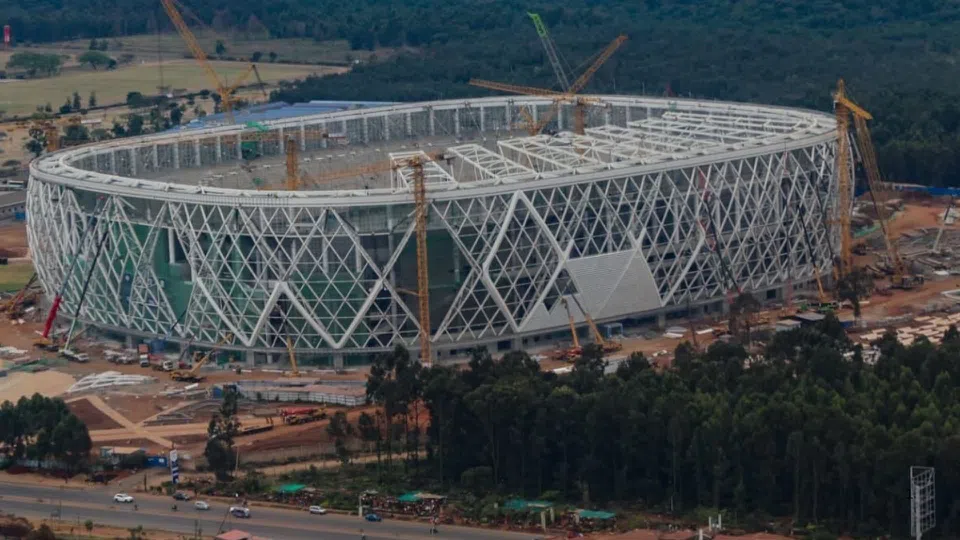
On the dusty stretch of Ngong Road where Jamhuri Grounds once hosted modest local fixtures, a new symbol of Kenyan sporting ambition is rising. At the heart of that transformation is Talanta Stadium construction, a project that is reshaping not just Nairobi’s skyline but also the national conversation on money, priorities and what it really takes to join the big league of African football hosts.
Talanta Sports City racing the clock for AFCON 2027
Talanta Sports City is more than just another stadium. It is Kenya’s flagship infrastructure project for the 2027 Africa Cup of Nations, which the country will co host, and the most significant sports build in almost four decades since Moi International Sports Centre Kasarani opened in 1987, preceded by Nyayo National Stadium.
Construction of the 60,000 seater Talanta Stadium started in March 2024 after a groundbreaking ceremony presided over by President William Ruto, then Sports Cabinet Secretary Ababu Namwamba in attendance. From that ceremonial turning of soil to the current concrete and steel skeleton, the project has been sold as a statement that Kenya is ready to host continental showpieces on home soil again.
The original target was to complete the stadium by 31 December 2025, but that deadline has already shifted. Sports Cabinet Secretary Salim Mvurya now projects that the facility will be fully completed and operational by 28 February 2026, comfortably ahead of AFCON 2027 but tight enough to keep engineers and planners under pressure.
How far along is Talanta Stadium
Recent site visits and official updates paint the picture of a project that is clearly past the halfway mark and rapidly taking shape as a modern arena. According to Mvurya, construction is around 66 per cent complete, with the stadium bowl, external shell and critical structural components already visible from the roadside.
Perhaps the most striking development has been the progress on the roof canopy metalwork. Massive steel trusses are now being lifted into place on top of the superstructure, forming the skeleton of the canopy that will shelter the three tier stands. This is advanced engineering work, and it signals that the outer form of the stadium is now entering its final phase of definition.
Equally eye catching is the curtain wall system that will wrap a large portion of the exterior. Workers have been fitting the framing and glass panels that will give Talanta Stadium a sleek, reflective façade, a far cry from the concrete heavy look that has defined many older African venues. Once completed, this curtain wall is expected to improve interior lighting and contribute to energy efficiency, not just serve as an architectural showpiece.
Inside the stands, the bones of the football cathedral are already in place. All terraces, the stepped concrete seating platforms that form the bowl, have been fully completed. From a distance they now rise in uniform layers, outlining the final shape of the venue and giving fans a clear sense of the scale that will greet them when AFCON finally rolls into town.
From shell to stadium what is being built behind the façade
With the terrace construction effectively finished, the focus is steadily shifting from raw concrete to the complex interior that turns a structure into a stadium. Partitioning is ongoing for the numerous rooms and specialised spaces that a modern elite venue demands, from changing rooms to hospitality suites.
Talanta Stadium is designed as a multi use, fully compliant international facility, and that ambition is evident in the specifications already confirmed. The arena will feature six changing rooms, an important detail for tournaments where consecutive matches and quick turnarounds are the norm. There will also be a dedicated VAR room, a doping control room and as many as 52 VVIP sky boxes, along with several lounges to cater to corporate and top level guests.
Parallel to the civil works, both electrical and plumbing installations are progressing. In some rooms, wiring is reportedly close to completion, an indication that fit out stages are already underway in parts of the complex. Staircases in the three layer stand structure are also being built, creating the circulation routes that will eventually move tens of thousands of fans in and out of the bowl.
On the roof, workers are using a sophisticated computerised hydraulic tension cable system. Rather than relying solely on compression, high strength cables are gradually fitted and tensioned using powerful hydraulic jacks. This modern engineering technique will help stabilise and support the canopy structure, a reminder that Talanta is not just big, but also technologically ambitious.
Once the external envelope and main concrete works are done, attention will finally turn to the heart of any football venue, the playing surface. Only after that green rectangle is in place will Talanta Stadium truly begin to feel like the home ground Kenyan football has long dreamed of.
New completion date and what it really means
Shifting deadlines are part of almost any large infrastructure project, but for a stadium tied so directly to AFCON 2027, every revised date becomes a national talking point. The new completion target of 28 February 2026 replaces an earlier ambition to be done by the end of 2025.
According to Salim Mvurya, the majority of exterior and major infrastructural works should be complete by the end of December 2025. That will then allow contractors to focus on the so called finishing works, including internal fit out, installation of seats, concourses, hospitality facilities and the playing surface, in the run up to full operationalisation by February 2026.
The Cabinet Secretary has also emphasised that Talanta Stadium is not an isolated island but part of a wider urban ecosystem. In line with what government officials describe as a whole of government approach, several ministries will be involved in complementary works, from rail connectivity and road upgrades to utilities and landscaping. The goal is to ensure that when the first ball is kicked, fans can reach the venue smoothly and the surrounding area matches the standards of the stadium itself.
A price tag that has ignited national debate
If the concrete and steel of Talanta Sports City tell a story of ambition, the numbers behind the project tell another, far more contentious tale. Officially, the government has put the cost of the stadium at 344.5 million dollars, roughly KSh 44.7 billion, as presented to the National Assembly’s Committee on Sports and Culture by the Ministry of Defence.
That alone makes Talanta Stadium the biggest single sporting infrastructure investment in Kenya in nearly forty years. It is also, inevitably, a magnet for scrutiny at a time when public finances are under pressure and many Kenyans are feeling the weight of taxes and a rising cost of living.
Among the most vocal critics is Kiharu Member of Parliament Ndindi Nyoro, a lawmaker known for interrogating government spending. He has claimed that the true cost of Talanta could be far higher than the official figure, raising concerns about what he describes as massive off the books government borrowing.
| CASINO | BONUS | INFO | RATING | |
|---|---|---|---|---|
|
bonus
500% bonus on first 4 deposits!
See 5 Bonuses
|
info
10 crash games, mobile-first site, 500% welcome bonus BK 000678 |

|
||
|
bonus
175% welcome package for new players!
See 4 Bonuses
|
info
Lots of interesting bonuses, players from many countries, long history No. 1668/JAZ |
|
||
|
bonus
Claim weekly freebet codes on Telegram!
See 5 Bonuses
|
info
6,000+ casino games, renowned providers, mobile-optimized gamesBK 0000761, PG 0000461 |
|
||
|
bonus
100% match bonus up to $500 for new users!
See 6 Bonuses
|
info
Lots of bonuses, 3,000+ games, instant-play & fast payouts No.1668 / JAZ |
|




The hidden cost claims around Talanta Stadium
At the centre of Nyoro’s criticism is the way Talanta Stadium is being financed. The initial payment cost of KSh 44.7 billion corresponds to an Infrastructure Asset Backed Security bond listed on the Nairobi Securities Exchange, a modern financing tool that effectively securitises future revenue streams.
Nyoro alleges that this is just the starting point. According to him, the loan secured for the 60,000 seat facility is to be serviced through the Sports Fund, with a requirement that government remits KSh 500 million every month for 15 years. If his calculations are accurate, that would mean KSh 9 billion paid out every year, adding up to KSh 135 billion over a decade and a half.
When combined with the original principal, Nyoro argues, the total cost to taxpayers would reach around KSh 145 billion. In his view, that KSh 100 billion in interest represents a hidden burden on future generations, one that is not clearly reflected in official Treasury debt statistics.
“At the end of 15 years, from a debt of KSh 45 billion, Kenya will pay interest of KSh 100 billion. So the total cost of the Talanta Stadium will be KSh 145 billion,” he told professionals gathered for the 42nd Annual Seminar of the Institute of Certified Public Accountants of Kenya in Mombasa.
Nyoro also used the Talanta example to make a broader argument about Kenya’s debt position. He claimed that while official numbers suggest a certain level of indebtedness, the reality is much worse once you factor in off balance sheet obligations, securitisations and various advances backed by fuel levy collections. In his assessment, the true debt to GDP ratio is above 70 per cent.
He was careful to stress that he is not fundamentally opposed to government borrowing. His main demand is for greater transparency, especially on projects of Talanta’s scale and visibility, where the line between visionary investment and risky leverage can be thin.
How Talanta compares to other African stadiums
Whenever the cost of Talanta Stadium is mentioned, the next question that instantly emerges is simple. Is Kenya overpaying. That debate has now spilled from parliamentary committees into matatus, social media timelines and football terraces.
To understand the context, it helps to look around the region. Tanzania’s Benjamin Mkapa Stadium in Dar es Salaam, completed in 2007, cost around 56 million dollars, about KSh 7.22 billion at the time, for a 60,000 seat facility. Of that, the Tanzanian government contributed roughly KSh 3.23 billion, with the rest coming as a grant from China.
In Uganda, Mandela National Stadium in Namboole, opened in 1997, cost about 36 million dollars, or KSh 4.64 billion, fully financed as a Chinese grant according to official documents. Its capacity is around 45,000, smaller than both Mkapa and Talanta, but the financial outlay was also dramatically lower.
Set against those figures, Talanta’s stated KSh 44.7 billion price tag, and Nyoro’s warning of an eventual KSh 145 billion total, naturally raises eyebrows. Even accounting for inflation, modern safety standards and the fact that Talanta is planned as a multi layer, highly specified complex with extensive hospitality and technology features, the gap is significant.
Looking south and north how do continental giants spend
A broader African comparison adds more layers. South Africa’s FNB Stadium, also known as Soccer City, is the only venue on the continent to have hosted a FIFA World Cup final. Built between 1986 and 1989, its original cost has been estimated between 373 and 440 million dollars, equivalent to about KSh 48.1 to 56.8 billion.
The 94,000 seat arena then underwent a major renovation ahead of the 2010 World Cup, which reportedly added another 400 million dollars, roughly KSh 51.6 billion. In simple terms, the total outlay to bring FNB to its current world class status was far higher than what Kenya is spending on Talanta at face value.
In North Africa, Morocco has invested heavily in a network of elite venues as it prepares to co host the 2030 World Cup. The Complexe Sportif Prince Moulay Abdellah in Rabat was rebuilt in 2023, after demolishing the original structure, at a cost of three billion dirhams, around KSh 42.5 billion. An additional KSh 9.2 billion went into a 25,000 seat athletics facility at the same site.
Morocco now boasts at least six such high level stadiums, proof that sustained, large scale spending on sports infrastructure can be part of a national strategy. In that sense, Talanta can be seen as Kenya’s attempt to enter a club where the likes of Morocco and South Africa already sit.
Ivory Coast, hosts of AFCON 2023, built the Alassane Ouattara Ebimpé Olympic Stadium in Abidjan at a cost of 257 million dollars, around KSh 33.15 billion. The Ivorian government funded about 56 per cent of that, and subsequent renovations took the total to 295 million dollars, roughly KSh 38.06 billion. That stadium hosted the AFCON 2023 final between Ivory Coast and Nigeria, a night when infrastructure investment and footballing payoff came together before the world’s cameras.
When Kenya looks at Europe the scale of spending shifts again
If African comparisons show that Talanta sits in a middle ground between modest regional builds and mega projects, a glance at Europe and the United States takes the discussion to another planet. The numbers there are staggering, but they also highlight how professional sport, urban development and branding converge at the highest level.
Manchester United, for example, have floated plans for a brand new stadium with an estimated cost of around 2 billion pounds, more than KSh 370 billion. Their current home, Old Trafford, cost a fraction of that when it was first opened in 1909, roughly KSh 16.73 million in then money, before decades of renovations transformed it into the Theatre of Dreams known today.
Arsenal’s Emirates Stadium, opened in 2006, reportedly cost about 390 million pounds, or around KSh 72.5 billion. That figure does not include the very significant amounts spent on land, transport links and long term financing, but it illustrates the scale of investment required to stay competitive at the top of European football.
Chelsea’s Stamford Bridge and Liverpool’s Anfield, both older grounds, were initially built for amounts that seem almost comical now, a few thousand pounds in the late 19th century. Yet over time, upgrades, expansions and compliance with modern standards have turned them into vastly more expensive assets.
On the global stage, the top tier of stadium construction costs is dominated by multi purpose American and Asian venues. SoFi Stadium in California, opened in 2020, reportedly cost the equivalent of about KSh 825 billion. Allegiant Stadium in Nevada is estimated at around KSh 285 billion, Yankee Stadium at KSh 273 billion, with a cluster of others like MetLife, Mercedes Benz Stadium and Wembley all ranging between KSh 165 and 240 billion.
These figures do not excuse waste in Kenyan projects, but they do offer perspective. Building a modern, high capacity, technologically advanced stadium is never cheap. The real issue is whether the design, usage plan and financing model justify the bill presented to the public.
The promise of Talanta Stadium for Kenyan sport
Beneath the headlines about debt ratios and interest repayments lies a more emotional current. For many Kenyan fans, Talanta Stadium is not just a ledger entry, it is the promise of finally having a home that matches their passion for the game.
For years, Harambee Stars have bounced between Kasarani and Nyayo, venues that carry memories but are also showing their age. Hosting AFCON 2027 with a truly modern 60,000 seat arena in the capital would be a statement that Kenyan football intends to stand shoulder to shoulder with the continent’s best, both on and off the pitch.
The facility is also expected to serve as a multi use complex, capable of hosting not only international football but concerts, athletics events and other major gatherings. If managed properly, that diversity of usage can help generate the revenue needed to justify its price, and perhaps ease the load on the taxpayer over time.
Sports officials, led by Salim Mvurya, have repeatedly framed Talanta as a cornerstone in positioning Kenya as a continental and global sporting powerhouse. In their narrative, the stadium is about more than 90 minute matches. It is about tourism, image, jobs and the belief that Kenyan athletes deserve world class stages.
Between ambition and accountability the road ahead
Even as the roof trusses lock into place and the curtain wall inches toward completion, the public argument around Talanta Stadium is unlikely to fade. On one side stand those who see it as an overdue investment in infrastructure and national pride. On the other are voices calling for stricter financial scrutiny, transparent contracts and a sober assessment of long term costs.
What is clear is that Talanta Sports City has already become a mirror reflecting Kenya’s wider struggles and aspirations. It sits at the intersection of football dreams and fiscal realities, of global ambition and local accountability.
If the project is delivered on time, within a clear and honest financial framework, and then run professionally, it could become a landmark that defines a new era for Kenyan sport. If mismanaged, it risks turning into a towering symbol of missed priorities and quiet liabilities.
For now, cranes continue to swing over Jamhuri Grounds, workers in hard hats move between terraces and steel beams, and the skeleton of a 60,000 seat arena grows more solid by the day. Talanta Stadium is no longer just a render shared on social media. It is a real, rising structure, and with every bolt tightened, Kenya edges closer to answering a compelling question. Can a stadium capture both the beauty of the game and the hard truths of the balance sheet, and still feel like home.