
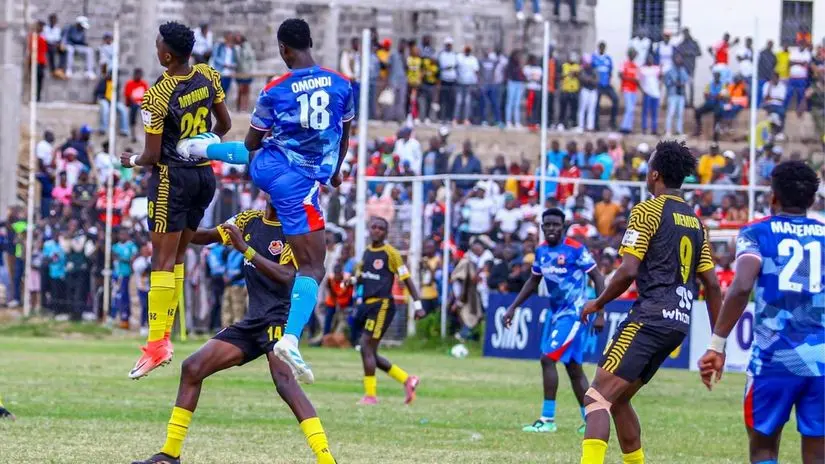
Few Kenyan clubs stir emotion quite like Shabana FC, and in recent days the Shabana FC developments story has captured both the hope and frustration that define local football. On one hand, there is the promise of an upgraded Gusii Stadium lifted to international standards. On the other, fans have just endured the disappointment of a TV blackout in a key Premier League clash against Murang’a Seal.
Together, these two threads tell a bigger story about where Shabana stand today. A community giant finding its feet again in the FKF Premier League, caught between infrastructural shortcomings and a renewed push from the highest levels of government to modernize the game.
From TV blackout in Murang’a to a national talking point
On Sunday, 24 November, Murang’a Seal hosted Shabana at St. Sebastian Park in a match that had been heavily anticipated by supporters around the country. It ended 1-1 on the pitch, but off the pitch it sparked a wider debate after the game failed to air on television despite earlier communication that it would be broadcast on KBC Channel One, a key partner in FKF Premier League coverage.
In a league where visibility is precious, especially for clubs with a mass following like Shabana, the blackout was a bitter pill to swallow. Social media quickly filled with speculation, accusations and frustration from fans who had cleared their afternoon to watch the Glamour Boys take on Seal.
FKF and Azam TV explain what went wrong
Football Kenya Federation, the FKF Premier League broadcasting partners Azam TV, and the two clubs were forced to respond. In a joint communication, they clarified that the Murang’a Seal vs Shabana fixture did not air due to capacity challenges on the side of the production company that had been contracted to cover the match.
The statement specifically rejected rumours circulating online that either Murang’a Seal or Shabana had anything to do with the failure. According to the communication, claims that the two clubs obstructed the broadcast were described as false and unfounded, a clear attempt to defend the integrity of the teams in the face of mounting criticism.
The federation and its partners went further, offering an apology to fans, sponsors and stakeholders for the mishap, while reaffirming their intention to improve the broadcast product. They underlined their commitment to expanding access to local football and to ensuring such disruptions are avoided in the future, an important message in a league still working to rebuild trust with supporters.
Why the blackout matters so much to Shabana supporters
For many Shabana fans, the pain of missing a live broadcast goes well beyond one match. The club is one of the most passionately supported sides in Kenya, drawing big crowds at home and neutral venues alike. For those who cannot travel, television is the lifeline that keeps them connected to every tackle, every pass, every mistake.
When that connection is abruptly cut, it adds to a long standing sense among supporters that their devotion is not always matched by the structures that run the game. It is why statements about capacity challenges, however genuine, are scrutinized closely whenever a club of Shabana’s stature is involved.
What happened on the pitch in Murang’a
Ironically, while the cameras stayed away, the match itself provided the kind of narrative that fans crave. Shabana started brightly, and in the eighth minute Wycliffe Owino gave the Glamour Boys the lead. It was the ideal start for a team keen to cement its status in the top half of the FKF Premier League table.
Murang’a Seal, fighting near the bottom, refused to fold. Veteran forward John Kiplagat drew them level in the 36th minute, and that 1-1 scoreline held until the final whistle. For Seal, it was a valuable point in their battle to climb away from danger. For Shabana, it was another reminder that in this league nothing comes easy, especially away from home.
After ten rounds of matches, Shabana sit eighth on 12 points. Murang’a Seal, meanwhile, are 16th with 10 points. The table paints a picture of two clubs on different trajectories, yet locked together for ninety minutes in a game that, for all its significance, could only be experienced by those present at St. Sebastian Park.
Gusii Stadium upgrade offers a different kind of headline
While the Murang’a blackout raised familiar questions about broadcasting, another story involving Shabana has offered something far more optimistic. President William Ruto has publicly committed to renovating Gusii Stadium in Kisii County and elevating it to international standards, a decision that carries huge implications for Shabana FC and for local football in the region.
Speaking in Kisii on Saturday, 22 November, the President did not mince his words. He acknowledged that the current facility is inadequate for a team of Shabana’s level, highlighting that Kisii is home to one of the country’s biggest clubs and deserves infrastructure that reflects that reality.
He stated that the stadium, in its present form, is below standard, especially given the size of crowds that Shabana typically attracts. For the fans who have often filled Gusii to the brim, sometimes in less than ideal conditions, it was a powerful recognition of their importance in Kenyan football.
The plan to expand Gusii Stadium to international standards
The blueprint outlined by President Ruto is ambitious. The government intends to relocate the Agricultural Society of Kenya offices, which currently sit on a five acre plot adjoining the stadium. This move would free up crucial space needed to expand the facility and turn it into a venue capable of hosting international events.
The President explained that discussions have already taken place with county leadership and with ASK officials. The plan is to move ASK to an identified 12 acre site, which would then allow the stadium footprint to grow. According to Ruto, a contractor is already on standby, waiting only for the county administration to complete the necessary paperwork before work can begin in earnest.
For Shabana and their supporters, phrases like international standards and national stadium translate into tangible dreams. More seats, better facilities, safer stands, improved pitch conditions, and the chance to host bigger matches. For Kisii, it is an opportunity to cement its place on the national sports map.
| CASINO | BONUS | INFO | RATING | |
|---|---|---|---|---|
|
bonus
Sign up for KES 46 bonus after first deposit!
See 11 Bonuses
|
info
20+ crash & instant games, Aviator bonuses BK 0000704 |

|
||
|
bonus
90 free spins weekly!
See 4 Bonuses
|
info
OGL/2024/137/0132 secure platform with top casino games & bonuses. |
|
||
|
bonus
500% bonus on first 4 deposits!
See 5 Bonuses
|
info
10 crash games, mobile-first site, 500% welcome bonus BK 000678 |
|
||
|
bonus
Casino Welcome Bonus
See 5 Bonuses
|
info
8048/JAZ2016-053, premium casino with live games, classic slots. |
|




Why Shabana might have to move home matches
There is, however, a short term price attached to such a long term gain. The very works that promise to transform Gusii Stadium mean that Shabana are likely to shift their home matches if construction begins during the season.
President Ruto himself hinted at the urgency, noting that his team is already on site and that delays in paperwork are the main issue holding back the start of construction. Once ASK is relocated and the legal processes are concluded, the contractor is expected to move quickly, and the stadium will effectively become a construction zone.
For a club so rooted in its home support, the prospect of playing home games away from Gusii is significant. It raises questions about where those matches will be staged, how many fans will be able to travel, and how the change will affect performance on the pitch. Home advantage in Kenyan football is often about more than the turf, it is about the noise, colour and pressure generated from the terraces.
How a modern Gusii could reshape Shabana’s future
Despite the likely temporary disruption, the upside of a renovated Gusii Stadium is enormous. A modern, international standard venue could change the club’s financial landscape through higher gate collections, improved hospitality, and the potential to host bigger fixtures, including high profile league matches or even continental ties in the future.
Better facilities can also influence the sporting side. Players often speak about the lift they get from playing in quality environments. A well maintained pitch, professional locker rooms and training areas can attract talent and raise standards. For a club eager to turn its mass support into consistent success, these are not cosmetic details, they are competitive tools.
Beyond Shabana, the stadium would be a hub for other local teams, including Gusii FC, and a focal point for youth competitions and community events. In that sense, the investment is not just into one club, but into the entire football ecosystem in the region.
Ruto’s wider stadium agenda and where Gusii fits in
The Gusii project is part of a broader pattern under President Ruto, who has placed sports infrastructure at the heart of his vision for Kenyan sport. At the national level, he has backed the construction of the Talanta Sports City Stadium in Nairobi, a 60,000 seat project at Jamhuri Grounds funded through a multi billion shilling infrastructure bond and built by China Road and Bridge Corporation.
Alongside new builds, his administration has overseen renovations at key national facilities including Moi International Sports Centre, Kasarani, Nyayo National Stadium and Kipchoge Keino Stadium in Eldoret, where the Ministry of Defence has been tasked with supervising upgrades. These investments are linked to Kenya’s co hosting of the 2027 Africa Cup of Nations and to the goal of restoring stadiums to international standards.
Crucially for regions like Kisii, Ruto has also spoken of decentralizing sports development. He has announced plans to build or renovate 25 stadiums across the country ahead of major competitions, and Gusii is among the grounds proposed for expansion. In addition, county level projects such as the new Kitui stadium, backed by a significant government investment, show that this approach is not limited to major urban centres.
The presidential gift that signalled belief in Shabana
The decision to upgrade Gusii Stadium arrives on top of another symbolic gesture from State House. In August, President Ruto pledged a brand new, modern team bus to Shabana, a promise that the club confirmed in a statement issued by Secretary General Elizaphan Kerama as the team, under coach Peter Okidi, prepared for the new season.
In that statement, the club spoke with genuine gratitude, describing the gift as a sign of the President’s belief in Shabana and in its millions of passionate supporters. As any player or coach will attest, a proper team bus is more than just transport. It speaks to professionalism, identity and pride, especially on long trips across a demanding league calendar.
For fans, seeing their club receive such visible backing from the head of state has reinforced the sense that Shabana’s importance goes beyond Kisii. It is a recognition that the Glamour Boys are part of the national football conversation again, not only as a nostalgic name but as a club worth investing in.
Between promise and pressure for the Glamour Boys
So where do these Shabana FC developments leave the club today. On one side, there is the frustration of missed exposure when matches like the 1-1 draw against Murang’a Seal fail to reach television audiences. On the other, there is the excitement of a future in which the club plays in a modernized Gusii Stadium and travels in a bus that reflects its status.
In sporting terms, Shabana sit eighth in the FKF Premier League table after ten rounds, neither in a relegation scrap nor firmly in the title conversation. It is a platform on which to build, especially if infrastructural improvements arrive to match the ambition of the supporters and the expectations that come with such a large fan base.
The pressure, of course, will also increase. Once a club is given facilities and visibility, excuses narrow. Fans will expect not just full stands and improved comfort, but also better results, more disciplined management and a professional environment from top to bottom.
What the Murang’a blackout tells us about Kenyan football
The missing broadcast from St. Sebastian Park was more than a technical failure. It acted as a reminder that Kenyan football is still in transition from amateurish habits to professional standards, not just on the field but in the way it is packaged and delivered to the public.
The fact that FKF, Azam TV and the clubs moved quickly to clarify what had happened, and to distance the teams from any wrongdoing, suggests that stakeholders understand the stakes. In an era where fans can follow European leagues at the click of a button, local football cannot afford repeated blackouts or miscommunications.
For Shabana, visibility is part of their identity. The club’s story is intertwined with that of its community, and television offers a way to project that story across counties and generations. Ensuring reliable coverage of big fixtures is therefore not a luxury, but a necessity, especially as the club fights for hearts and minds among younger fans.
The road ahead for Shabana and Gusii
In the coming months, much will depend on how quickly the paperwork around the Gusii Stadium expansion is completed, and how soon contractors move in. Once that happens, Shabana’s temporary exile from their traditional home will begin, and the logistical challenges will test both administrators and supporters.
At the same time, the FKF Premier League will continue to demand weekly focus. Matches like the draw against Murang’a Seal will keep coming, each with its own pressures and narratives. Wycliffe Owino’s goals, John Kiplagat’s experience, the tactical decisions of Peter Okidi, all these details will shape the club’s fortunes while the concrete and steel of Gusii’s future are being laid.
What is clear is that Shabana find themselves at a pivotal moment. For once, the biggest headlines around the club are not about mismanagement or decline, but about investment, infrastructure and the growing recognition of their importance to Kenyan football. If the stadium upgrades are delivered, if broadcasting partners raise their game, and if the team continues to hold its own in the league, the Glamour Boys could be on the brink of a new chapter worthy of their history.
In the end, the story of Shabana is still written by the people who wear their colours to Gusii, to Murang’a and to every corner of the country. The recent developments, from the TV blackout apology to the promise of an international standard home, only underline one truth. Kenyan football is at its best when it remembers that the heart of the game beats loudest in clubs like Shabana FC, where passion, politics, infrastructure and performance collide every single week.