
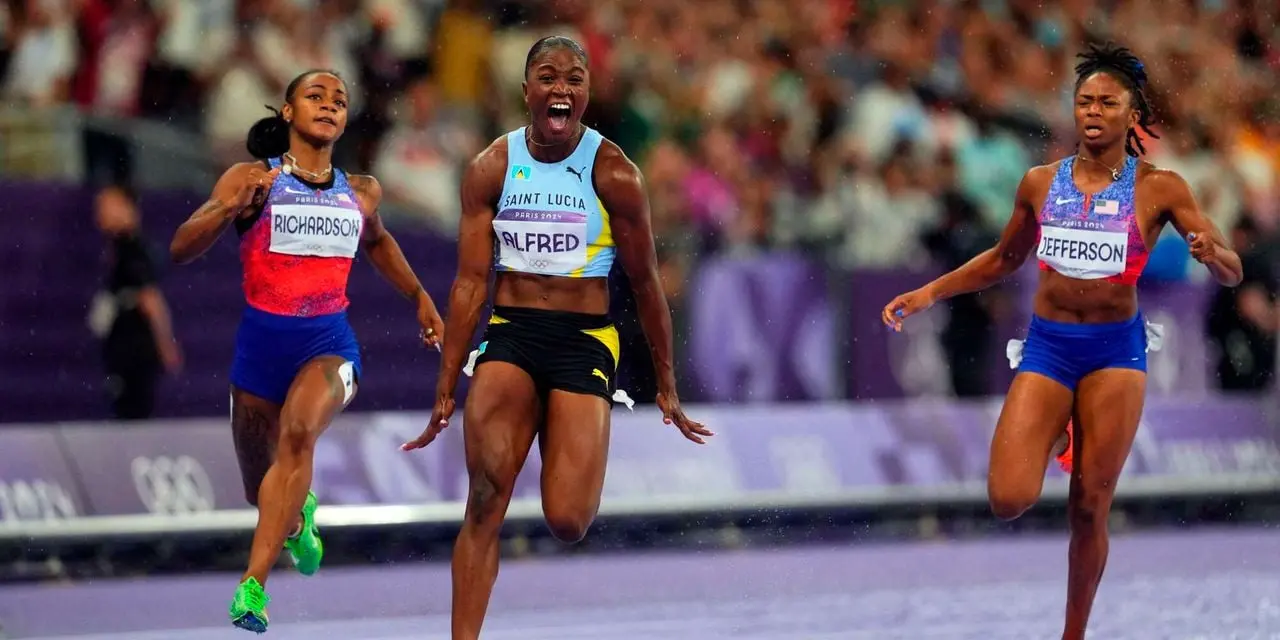
The decision to place the LA 2028 Olympics women’s 100m final on the very first day of athletics is far more than a scheduling tweak. It is a statement of intent about what kind of Games Los Angeles wants to stage, who it wants to spotlight, and how it wants the world to experience the Olympic story from the opening gun.
Women’s 100m lights the fuse on day one
Organisers have confirmed that the women’s 100 metres final will headline the first day of competition in track and field at LA 2028, with every round of the event packed into a single day. In Olympic terms, this is a bold reshaping of the traditional rhythm of athletics, where sprint finals usually build over several days of heats, quarterfinals and semifinals.
World Athletics President Sebastian Coe revealed that the format and timing had been extensively discussed with athletes and coaches. Their response, he said, was clear and enthusiastic, describing support as “overwhelmingly” in favour. For sprinters used to chasing fractions of a second, the idea of chasing history in a one-day sprint marathon seems to have captured the imagination more than it has raised concerns.
Coe framed the move as an opportunity rather than a risk. In his words, the question from athletes was simple, why would you not want to open with that kind of flair off the back of the first day. From a sporting narrative perspective, it means the Games will not ease into the action, they will explode into life the moment the sprinters settle into their starting blocks.
“We want to open with a bang”
That sense of deliberate spectacle was echoed by Shana Ferguson, LA28’s chief of sport and games delivery, who distilled the strategy into one line, “We want to open with a bang.” The women’s 100m, long regarded as one of the most watched and most replayed races of any Olympics, is being used as the fuse that sets off the entire athletics program.
Ferguson described the race as “one of the most-watched races of the Games”, and the decision to move it to day one reflects that global pull. For broadcasters and digital platforms, it offers a perfect early peak, a signature final that grabs casual viewers and hardcore fans alike. For the athletes, it means stepping into the stadium knowing they are not a warm-up act, but the feature show of the opening night.
The choice also recognises the modern Olympic audience, always connected, always sharing. A dramatic women’s 100m final on day one is likely to dominate timelines, trend lists and highlight reels, setting a tone of equality and intensity that LA28 has been keen to project.
Athletics moves into week one and swimming shifts
Behind the eye-catching decision to front-load the women’s 100m is a more complex piece of logistical choreography. LA28 officials confirmed that athletics will be held at the historic LA Memorial Coliseum and scheduled primarily in week one of the Games. Meanwhile, swimming shifts mainly into week two, with both sports connected by SoFi Stadium.
SoFi Stadium will host parts of the Opening Ceremony as well as swimming, which created a logistical puzzle. The solution was to let athletics run first at its own venue, while giving organisers time to convert SoFi for aquatics in the second week. Venue logistics are rarely glamorous, but in this case they have led directly to one of the most striking programme changes of the Olympic cycle.
By putting track and field front and centre earlier than usual, LA 2028 effectively rewrites the emotional pacing of the Games. Instead of building slowly to a track crescendo late in the fortnight, fans will get sprint fireworks almost immediately, then settle into a second week that features swimming stars making their own waves at a transformed SoFi Stadium.
A new Olympic experience for swimmers
For swimmers, the reshuffled calendar could change the feel of their entire Games. Janet Evans, a four-time Olympic champion in swimming and now LA28’s chief athlete officer, underlined one key benefit, more swimmers will finally have a realistic chance to take part in the Opening Ceremony.
In many previous Olympics, swimmers have skipped the parade or left early from the stadium because heats awaited them the next morning. By placing swimming primarily in week two, LA28 hopes to remove that dilemma. Evans spoke of a component of the Olympic experience that organisers want athletes to have, a clear reference to the emotional lift of walking into a packed stadium in national colours.
It may sound symbolic, but for athletes the Opening Ceremony can feel like a once-in-a-lifetime moment. Structuring the schedule so that more competitors, particularly swimmers, can enjoy it reflects the broader LA28 theme of athlete-centric planning, where competitive demands and experiential elements are both treated as central, not competing, priorities.
Day one belongs to women’s sport
The women’s 100m final will not stand alone on that first day. Organisers confirmed that day one will also award the first LA28 medals in the women’s triathlon and that the opening programme will feature the most women’s finals ever contested in a single day at an Olympic Games.
In practical terms, this means the first Olympic champions crowned in Los Angeles in 2028 will likely be women. Symbolically, it is powerful. For decades, the Olympic narrative has often been built around men’s events as the default centrepiece. LA28 is making a conscious effort to reverse that tradition and place women’s sport at the core of its opening chapter, rather than as a supporting act.
From a storytelling standpoint, this offers a rich canvas. Day one will not just be about a single race, it will be about a cluster of women’s events, from the explosive sprint of the 100m to the endurance and tactical depth of the triathlon. Fans who tune in for the blue riband track event will also be introduced to a wider range of female athletes chasing history in different disciplines, united by the same LA 2028 Olympics stage.
Innovative sprint format with every round on one day
One of the most intriguing details revealed by Coe is that all rounds of the women’s 100m will be contested on the same day. Traditionally, sprinters navigate qualifying rounds over several days, managing energy, nerves and recovery between races. Compressing that journey into a single day changes the competitive texture of the event.
From a viewer’s perspective, it offers a narrative that plays out almost in real time. Morning heats, perhaps afternoon semifinals, then an evening final, all within a single emotional arc. For the athletes, it will demand meticulous preparation, from warm up strategies and nutritional plans to mental routines that keep them sharp for every call to the blocks.
Coe described the plan as innovative, highlighting that the consultation process with athletes and coaches was not a box-ticking exercise but a genuine attempt to align a bold idea with those who must execute it on the track. The fact that support was described as “overwhelming” suggests many sprinters relish the chance to own an entire day of the Olympic calendar.
| CASINO | BONUS | INFO | RATING | |
|---|---|---|---|---|
|
bonus
Sign up for KES 46 bonus after first deposit!
See 11 Bonuses
|
info
20+ crash & instant games, Aviator bonuses BK 0000704 |

|
||
|
bonus
90 free spins weekly!
See 4 Bonuses
|
info
OGL/2024/137/0132 secure platform with top casino games & bonuses. |
|
||
|
bonus
New players get 50 free spins and a Ksh 2500 freebet!
See 7 Bonuses
|
info
BK 0000665 PG 0000405 Good combination of online casino and betting platform |
|
||
|
bonus
Win Ksh 30,000 daily in Aviator tournament!
See 8 Bonuses
|
info
20+ software providers, Aviator+ other crash games, BK 0000671 PG 0000428 |
|




Balancing athlete welfare, TV windows and the elements
Shana Ferguson explained that the broader LA28 schedule was built over months in cooperation with the International Olympic Committee and international federations. This was not free-form experimentation, but a careful balancing act involving athlete welfare, broadcast needs and local conditions, from heat and tides to sun angles for outdoor events.
Weather was a central consideration, not only for the athletes but for fans in the stands as well. Los Angeles in the summer can be unforgiving, and the timing of events, particularly those that last over extended periods such as marathons or triathlons, must take into account safety and comfort. Ferguson added that the welfare of horses in equestrian events was also factored in, a reminder that high-performance sport often involves not only human but also animal athletes.
For the women’s 100m, this likely translates into an evening final, when temperatures are milder and television audiences around the world are sizeable. The meticulous reference to sun angles hints at an awareness of visibility, glare and even the visual quality of the broadcast, since a race that can be replayed millions of times should look as good as it feels. These elements together show a Games that is trying to be both spectacular and scientifically considerate.
Super Saturday and a packed second week
While day one will be shaped by women’s sport, organisers have also drawn a red circle around Day 15, which they are already calling a “Super Saturday.” On that day, fans can expect 26 medal sessions across 23 sports, a schedule that promises a whirlwind of podium ceremonies, flag raisings and an almost non-stop stream of decisive moments.
By highlighting this late-Games peak, LA28 is sketching a narrative arc that starts with a bang and ends with a flood of medals. The packed programme reflects the breadth of the modern Olympic movement and may also play into broadcast strategies, with a festival of finals designed to hold global audiences right up to the final weekend.
Organisers also expect women to make up more than half of athlete quotas overall, reinforcing the message that gender balance is not a slogan but a structural choice. The inclusion of new sports such as flag football and squash, along with the return of cricket, lacrosse and baseball or softball, adds variety and opens new doors for athletes and fans, widening the Games beyond traditional Olympic staples into fresh sporting cultures.
Ticket strategy and venue footprint
On the ground in Southern California, LA28 is planning for scale that is both massive and consciously managed. Ferguson outlined an ambition to sell about 14 million tickets across 51 Olympic sports in 49 venues. Public ticket sales are scheduled to begin in April 2026, following a registration phase in January of that year.
For the initial ticket release, pricing will be fixed and will not rely on dynamic pricing models that adjust in real time based on demand. That decision is significant in an era where dynamic pricing has become common in major sports and entertainment. LA28 has also signalled that it will present specific measures to address secondary market concerns closer to the on-sale date, an attempt to balance accessibility, fairness and financial realities in a Games of this scale.
In terms of infrastructure, organisers stated that 77 per cent of sessions will take place in existing venues, while 23 per cent will be hosted in temporary sites such as the Sepulveda Basin and Long Beach. More than 90 per cent of temporary materials are expected to be reused or repurposed, a figure that reflects the sustainability goals that modern Olympic hosts are increasingly judged on, both by the public and by the IOC itself.
Extending the Games beyond Los Angeles
One of the more intriguing details in the venue plan is the decision to stage softball in Oklahoma City, using existing facilities there. Janet Evans described the setup as providing “world-class” conditions while also broadening the geographic reach of the Games within the United States.
This approach underlines that LA28 is not only a Los Angeles story, but a national one. By leveraging established venues beyond California, organisers can reduce the need for costly construction while tapping into strong local fan bases and sporting traditions. For softball, Oklahoma City is already synonymous with elite competition, so bringing Olympic play there connects the Games to a community that lives and breathes the sport.
Behind the scenes, LA28 officials said they are working with local, state and federal authorities on visas and event delivery, and have a dedicated visa assistance team to support pre-Games and Games-time travel. For thousands of athletes, coaches and officials, smooth entry procedures are invisible when they work well, but can become major obstacles when they do not. The proactive creation of a dedicated team signals that organisers see this as a core operational priority, not an afterthought.
What this means for women’s athletics at LA 2028
Putting the women’s 100m final on the opening day of athletics at the LA 2028 Olympics does more than shake up a timetable. It sends a clear message about who will define the early narrative of the Games. The first major sprint story in Los Angeles will belong to women, not in the shadow of another event, but as the main act.
From a sporting perspective, it challenges sprinters to be ready to deliver their peak performance at the very moment the world starts paying attention. From a symbolic perspective, it inverts the outdated assumption that men’s events must necessarily anchor the biggest stages. The combination of the women’s 100m, women’s triathlon and a record number of women’s finals on day one is a powerful alignment of scheduling and principle.
Across the broader programme, LA28’s choices on venue use, ticketing, new sports and athlete experience suggest a Games that is trying to be both modern and rooted, ambitious and practical. Yet when the torch is lit and the cameras focus on the LA Memorial Coliseum, it is the shortest race in athletics, run by the fastest women in the world, that will set the emotional tone.
In a city defined by premieres, red carpets and opening nights, giving that honour to the women’s 100m is entirely fitting. The sprint that has so often crowned Olympic legends will, in 2028, begin the story instead. From the moment the starter’s pistol cracks the Los Angeles air, the message will be unmistakable, these Games are built to let women lead from the very first stride.