
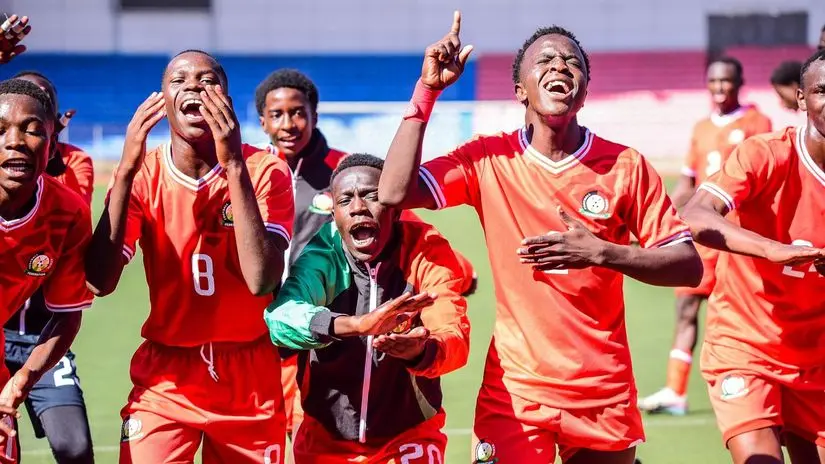
AFCON U-17 Qualifiers Kenya vs South Sudan in Addis Ababa delivered exactly what this young Kenyan generation has been promising all week, control, conviction and a cold blooded finish when it mattered most.
On a cool Monday afternoon at Abebe Bikila Stadium, the Junior Stars handled pressure that would weigh on seasoned professionals. A 2-0 win over South Sudan not only extended their unbeaten run in Group A, it also booked their ticket to the semi finals of the CECAFA U17 AFCON qualifiers and kept alive a dream that has been carefully built through grit against Somalia and Rwanda.
From survival mode to statement win
This Kenyan journey in Addis Ababa did not start with comfort. Their opening match against Somalia was a test of mentality in a hostile atmosphere, where they were pushed to the limit and had to settle for a 1-1 draw. In their second outing against Rwanda, they had to come from behind, with substitute Nicholas Ochola inspiring the turnaround and setting up Trevor Nasasiro for a 2-1 victory that kept qualification hopes burning.
By the time South Sudan appeared on the schedule, the stakes had changed. Kenya sat second in a five team Group A with four points, trailing leaders Ethiopia, while South Sudan had only one point from a draw with Somalia. For coach William Muluya, this clash was not just another group match, it was the hinge on which their whole qualifying campaign would swing.
Muluya’s warning before kick off
In the build up, Muluya cut a figure of calm urgency. He reminded his squad that South Sudan, wounded from their loss to Ethiopia, would come in desperate to stay alive. More importantly, he underlined that Kenya’s qualification would depend heavily on this game.
He demanded two things from his young players, sharper urgency in attack and improved defensive discipline. The Junior Stars had scored three goals in their first two matches and had conceded first in both, something both coach and players knew could not continue if they wanted to control their destiny in this tournament.
Why early goals mattered so much
With games arriving in quick succession and the strain of playing on artificial turf, recovery had already become a tactical pillar for Kenya. Muluya spoke openly about how his squad was carrying knocks, explaining that two or three key players were not at full fitness, but he trusted the depth of his group to step in and execute the plan.
His solution was as simple as it was bold. If Kenya could strike early, ideally with two or three goals in the first half, they could then manage the physical load better, control tempo and avoid exhausting themselves while chasing games. Above all, they had to defend well and, in the words of match winner Nasasiro from the Rwanda game, avoid conceding first and creating confusion.
Fast start brings the perfect platform
The response from the Junior Stars against South Sudan was almost textbook. Kenya entered the match with purpose, controlling possession and dictating rhythm from the opening minutes. Every passing sequence carried intent, every set piece felt rehearsed and deliberate.
The breakthrough arrived early, exactly as Muluya had hoped. After a well worked move down the right, a long, precise free kick from Cosmas Masita picked out Trevor Nasasiro in space. With typical composure, Nasasiro slid a perfect pass across the box where David Wanyonyi calmly finished in the 11th minute, giving Kenya a deserved 1-0 lead and immediate control of the contest.
Kenya take command of the first half
Once in front, the Junior Stars did not retreat into their shell. They pressed forward with confidence, pinning South Sudan back and looking for the cushion goal that would allow them to manage the game on their own terms.
In the 24th minute, Nicholas Acholla, who had been lively down the flank, forced the South Sudan goalkeeper into a save with a direct free kick. Just three minutes later, another flowing Kenyan move ended with Raphael Omondi trying his luck from distance, his shot drifting just wide but reaffirming how dominant Kenya had become in open play.
Armstrong Omondi then stepped up on set piece duty in the 31st minute. His free kick took a deflection for a corner, and from the resulting delivery he connected again, drawing yet another test for the keeper. For stretches of the first half, Kenya turned the South Sudan box into a training ground for finishing, varied attacks, from free kicks and long passes to quick combinations at the edge of the area.
South Sudan hang on as Nasasiro stays dangerous
One of the recurring themes of this qualifying campaign has been the influence of Trevor Nasasiro in the final third. Against Rwanda he had scored the equaliser and the winner, and here again he was a constant menace.
Before the break, Nasasiro troubled the goalkeeper with a low drive from the right as Kenya pushed hard for a second goal. Acholla meanwhile showcased excellent close control, spinning away from a defender, cutting inside and winning another corner with a deflected effort. Yet despite the pressure, South Sudan clung on and reached halftime only one goal down, a minor victory for them given the flow of the game.
A nervous spell after the interval
If the first half belonged to Kenya, the start of the second belonged to South Sudan. Clearly instructed to be braver and more direct, they came out with renewed energy and almost stunned the Junior Stars on the counter.
In the 54th minute, David Darako broke through on goal after a quick transition, only to drag his shot wide in what stood as South Sudan’s best chance of the match. It was a reminder that in tournament football, dominance on the ball means little if you leave the margin at a single goal.
Omondi drives Kenya forward again
Kenya reacted to that warning with composure. Midfielder Armstrong Omondi took responsibility in possession, demanding the ball and looking to reassert Kenyan control. In the 63rd minute he went close himself, unleashing a powerful strike from outside the box that forced goalkeeper Daniel Lombe into a strong save.
At that point, the contest was delicately poised. Kenya were still the better team, but South Sudan were one swift move away from levelling. Muluya, aware of the physical toll and the need to keep energy high for the closing stages, turned to his bench.
Impact from the bench and fresh legs on the flanks
Nasasiro and Omondi, who had both run tirelessly, made way for Ray Ochieng and Brighton Nacheri. The idea was clear, inject fresh pace, especially down the wings, and stretch a tiring South Sudan defence that had been forced to chase and defend for most of the game.
Nacheri in particular immediately justified his introduction. He attacked the flanks with aggression, constantly looking to burst into space and commit defenders. In the 83rd minute he broke free and fired narrowly wide, then two minutes later he missed another opportunity after being superbly picked out by Julius Buong.
The decisive late punch from Nacheri and Nasasiro
Those misses could have haunted a less resilient player. Instead, Brighton Nacheri kept asking for the ball and kept driving forward. In the 88th minute he received that chance again, breaking into space on the wing with South Sudan stretched and vulnerable.
This time, he chose the perfect option. Nacheri squared the ball to Trevor Nasasiro who, back on the pitch after his earlier influence, slotted home to make it 2-0 and finally put the game beyond South Sudan’s reach. It was a goal that summed up Kenya’s approach, patient build up, intelligent use of width, and a ruthless touch when the opening appeared.
Defensive steel under pressure
Although the scoreline reads 2-0, the story of this match also lives in what happened in Kenya’s own penalty area. South Sudan were most dangerous from set pieces, something Muluya himself acknowledged later when he praised his side for how they defended those situations and rectified their own mistakes.
Throughout the second half, Kenya had to deal with aerial deliveries and physical challenges. The defensive unit, shielded by disciplined midfield work, kept composure, blocked shots and cleared danger with conviction. It was not flawless, as the coach admitted, but it was resilient, which at tournament level can matter more than perfection.
Coach Muluya’s honest appraisal of the performance
After the final whistle, William Muluya was proud but far from complacent. He highlighted the importance of the win and the clean sheet, acknowledging that South Sudan had created chances, especially from set pieces, and that many of those opportunities had stemmed from Kenyan mistakes.
He praised his players for being able to commit errors, then recover and defend well, calling that a positive sign of maturity. At the same time, he was candid that this was not the best performance Kenya could deliver and that a higher level would be needed in the decisive matches to come, particularly against the physically strong Ethiopian side backed by home support.
| CASINO | BONUS | INFO | RATING | |
|---|---|---|---|---|
|
bonus
First Bonus: 200% Deposit Bonus
See 3 Bonuses
|
info
8048/JAZ2024-001 HunnyPlay is licensed under Curaçao (365/JAZ). Join now and win crypto instantly! |

|
||
|
bonus
50% bonus on second deposit!
See 18 Bonuses
|
info
Mobile friendly with 24 support & Curacao license and a lot of bonuses |
|
||
|
bonus
100% match bonus up to $500 for new users!
See 6 Bonuses
|
info
Lots of bonuses, 3,000+ games, instant-play & fast payouts No.1668 / JAZ |
|
||
|
bonus
Earn 10% cashback on your Aviator net losses!
See 6 Bonuses
|
info
Large welcome bonus, crypto-friendly, huge provider list. OGL/2024/1394/0725 |
|




Psychology and recovery ahead of the Ethiopia clash
With the victory over South Sudan, Kenya moved to seven points, level with Ethiopia at the top of Group A, and guaranteed their place in the knockout stage. The final group match, rescheduled along with the rest of the fixtures by the CECAFA Secretariat, will now determine who finishes as group winner.
Muluya knows that the margin for error is shrinking. He spoke of the need for rotation, noting that the same core of players has logged heavy minutes, and that with less than 24 hours at times between games, recovery is almost as important as tactics. For the knockout phase, he stressed that mentality, not just systems, will decide who advances.
Nasasiro’s growing influence on the Junior Stars
One of the most compelling narratives of this Kenyan campaign is the form of Trevor Nasasiro as a decisive attacking figure. Against Rwanda he was the hero, scoring the equaliser and the winner in a dramatic comeback. Against South Sudan he assisted the opener through his involvement in the move that led to Wanyonyi’s goal, then scored the second late on after combining with Nacheri.
His own words earlier in the tournament echo through Kenya’s recent performances. He had called for calmness, for the team not to concede first and avoid chaos. Against South Sudan, his teammates delivered on that demand, and he repaid them by turning their dominance into goals.
How Kenya have evolved from game to game
Across three matches, the Junior Stars have shown a clear evolution. In their opener against Somalia, they survived more than they imposed themselves, battling a hostile environment and early scares to escape with a point. Against Rwanda, they blended resilience with attacking bravery, coming from behind to win and keeping their hopes alive.
By the time they met South Sudan, the same group looked more assured, more certain of who they were and how they should play. Early goals, structured pressing, better game management and improved set piece defending all combined into a performance that, while not perfect, sent a message that Kenya are not in Ethiopia just to participate, they are there to compete for a ticket to the continental showpiece.
The wider stakes of the CECAFA qualifiers
The context around this tournament makes every match larger than the scoreline. The CECAFA qualifiers will produce three teams that move on to the AFCON U17 finals next year, which means margins are thin and every dropped point can become costly as the competition progresses.
With semi finals scheduled for November 30 and the final set for December 2, the calendar is tight, demanding both tactical clarity and physical robustness. For Kenya, reaching the semi finals is a significant achievement, but it also raises expectations back home where every Kenyan result in Addis Ababa is followed closely by fans eager to see another generation carry the national colours onto the continental stage.
Why the South Sudan win matters beyond the scoreboard
From a purely statistical view, a 2-0 victory, two wins and a draw in the group, and an unbeaten record paint a successful picture. Yet the real significance of this particular win lies in how it validates the messages Muluya and his staff have drilled into the squad since day one.
They asked for defensive solidity, for early goals to ease pressure, for mental strength when fatigue and knocks creep in, and for the ability to correct mistakes on the pitch. Against South Sudan, the Junior Stars ticked each of those boxes in crucial moments, from Masita’s precise delivery at 0-0 to Nacheri’s late burst and Nasasiro’s ice cool finish.
Key takeaways from Kenya vs South Sudan
- this is how it is done, Kenya finally started fast, scoring in the first quarter of an hour and avoiding the bad habit of conceding first
- this is how it is done squared, set piece defending improved in a match where South Sudan were most dangerous from dead balls
- this is how it is done cubed, squad depth proved vital, with substitutes like Brighton Nacheri and Ray Ochieng injecting the energy needed to finish the job.
Each of these themes will matter even more against Ethiopia, a side that, as Muluya noted, have the tournament’s top scorer, strong physical attributes and a passionate home crowd acting as a twelfth man.
Looking ahead to the showdown with Ethiopia
The group decider against Ethiopia is shaping up as one of the most anticipated matches of the CECAFA qualifiers. Both teams are unbeaten, both have already secured semi final places, yet the prize of topping the group and carrying momentum into the knockouts adds an extra layer of tension.
From a tactical perspective, Kenya will need to maintain their improved defensive discipline while also trusting the creativity of players like Nasasiro, Wanyonyi and Acholla in the attacking third. Ball circulation, as Muluya has stressed, will be crucial to limiting Ethiopian transitions and quieting the home crowd for stretches.
The emotional heartbeat of a young Kenyan side
Beyond tactics and formations, there is a human side to these qualifiers that is impossible to ignore. These are teenagers, many of them still learning what it means to play under real pressure for their country, adjusting to demanding schedules, artificial surfaces and the mental rollercoaster of tournament football.
From surviving a storm against Somalia to roaring back against Rwanda and then calmly taking care of business versus South Sudan, the Junior Stars have already packed a full spectrum of emotions into their stay in Addis Ababa. Each match has chipped away at their naivety and added layers of belief and identity to a group that is discovering, in real time, what it means to represent Kenya on a regional stage.
Conclusion Kenya’s statement of intent
The 2-0 win in the AFCON U-17 Qualifiers Kenya vs South Sudan fixture will be remembered as more than just a clean sheet and three points. It was a statement of intent from a Kenyan side that now carries the weight of expectation into the latter stages of the CECAFA tournament.
They are unbeaten, they are growing with every game and, most importantly, they have shown that when the pressure rises and the stakes become real, the Junior Stars can find poise, precision and personality. With a semi final berth secured and a group decider against Ethiopia on the horizon, Kenya’s young talents have earned the right to dream of AFCON U17, and they have done it the hard way, together.