
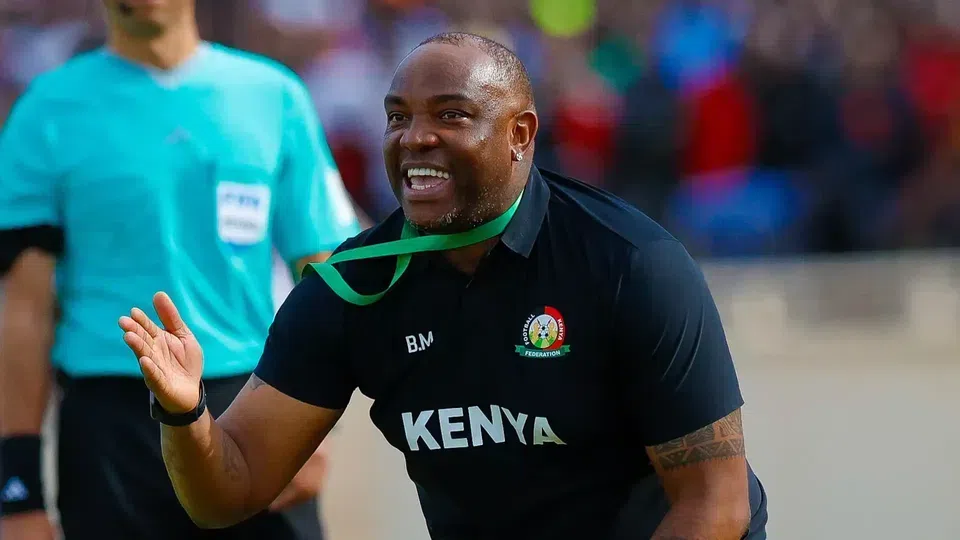
In a football world often driven by rivalry and quick fixes, Benni McCarthy’s comments on African football land like a thoughtful pause. The Harambee Stars coach is looking both inward to Kenya and outward to the continent, urging a rethink of how national teams are built and how African nations treat each other once the final whistle goes.
From Bafana Bafana legend to Harambee Stars leader
Benni McCarthy’s journey gives his words a particular weight. He is not just any foreign coach passing through Nairobi. He is a former Bafana Bafana star, a record holder for South Africa, and a coach who has worked at the highest club level, including Manchester United. That history means his attachment to South Africa is deep, even as he now gives everything to Kenya.
Speaking to Sporty TV, McCarthy admitted that his heart still beats for Bafana Bafana. He explained that playing for South Africa shaped who he is and cemented his football identity. It is where he became the player the world came to know, and he continues to monitor their progress with keen interest, even while he stands on the touchline for Harambee Stars.
Why Benni is proud of Bafana Bafana’s local core
When McCarthy looks at his homeland, one thing fills him with particular pride. He sees a South Africa side that has built a robust national squad from players based almost entirely in the domestic Premier Soccer League, a model he believes can inspire the rest of the continent, including Kenya.
He points out that South Africa are among the rare national teams whose squad is almost completely assembled from local players. For McCarthy, this is not just a romantic idea about homegrown heroes. He sees it as proof that the South African league has grown strong, competitive, and technically solid, giving Bafana Bafana a reliable platform for international success.
The Hugo Broos revolution in South Africa
The foundations of that South African model were reinforced when Hugo Broos took over in 2021. Many in the country still remember how bold, even shocking, his early decisions were. Broos sidelined a number of established internationals who were plying their trade overseas and chose instead to prioritise players from the local PSL.
This selection policy, radical at the time, put youth, freshness, and domestic cohesion at the centre of the national project. Broos wanted a team built on work ethic and fitness, yes, but also on the familiarity that comes from playing week in, week out in the same competitive environment. In short, Bafana Bafana began to look like a genuine extension of the South African league.
How the domestic league sharpened Bafana Bafana
McCarthy has been clear about the effect that a strong domestic structure can have. He praises the Premier Soccer League as a platform that is good and strong enough to prepare players for the international arena. In his view, the proving ground at home makes it far easier for players to lift their level when they face the best in Africa and beyond.
He notes that when your entire squad is based in a competitive domestic system, the step up to international football is more of a natural rise than a shock. That connection between local competition and national performance is what McCarthy finds so inspiring about South Africa’s current setup.
What Kenya can learn from South Africa
Now as Harambee Stars coach, McCarthy is looking to apply those lessons in Kenya. He has identified one major aspect that Kenya can borrow from South Africa to raise the standard of its domestic league and by extension its national team. At the heart of his message is a simple idea, build a stronger league and you build a stronger Harambee Stars.
He suggests that Kenya can study how South Africa has structured its football, then adapt that knowledge to local realities. That does not mean copying everything blindly. Instead, it means taking what works, especially the focus on local players, and combining it intelligently with Kenya’s existing strengths and its pool of international based footballers.
Building a more competitive Kenyan Premier League
For McCarthy, a more competitive Kenyan domestic league is both the starting point and the long term solution. He believes that improving the league will automatically raise the level of Kenyan players. Better competition at home forces players to improve technically, physically, and mentally, which then increases their ability to compete on regional, continental, and global stages.
He does not argue for shutting the doors on players abroad. Instead, he envisions a balance where a strong domestic core is complemented by the quality and experience of international based stars. In that mix, the national side benefits from both chemistry and exposure, something he has seen at close quarters with South Africa.
Local players as the backbone of Harambee Stars
McCarthy’s admiration for the South African system is clearly shaping his thinking in Nairobi. Just as Broos looked within the PSL, McCarthy wants to see Kenyan based players become a reliable backbone of Harambee Stars. A national team built on players who see each other frequently, who compete against each other every week, and who understand local football culture can grow more quickly and more cohesively.
Such a spine can then be enhanced by the presence of foreign based Kenyans, who bring different tactical experiences and pressures from abroad. The key, in McCarthy’s view, is to ensure that the domestic league is strong enough that local players are trusted, respected, and tested before they wear the national shirt.
A thinly veiled critique of past Harambee Stars management
In speaking about his plans, McCarthy has not avoided reflecting on the past. He has aimed what has been described as a thinly veiled dig at previous Harambee Stars coaches, expressing surprise at some of their decisions and highlighting missteps he is now trying to correct. The implication is that the national team was not always built on the most coherent strategy.
While he has not gone into every detail publicly, his emphasis on structure, domestic development, and clear selection principles suggests that he wants to break with a past he viewed as inconsistent. Rather than short term fixes, he is advocating for a sustainable model where the league and national team grow together.
From Mashemeji Derby energy to national ambition
Kenyan football is not short on passion. The Mashemeji Derby between AFC Leopards and Gor Mahia remains one of the most intense fixtures on the continent, with victories described as historic and deeply symbolic. The AFC Leopards chairman recently called a derby win a huge boost for morale and club pride, underlining how much energy already exists inside the local game.
McCarthy’s challenge is to channel that kind of intensity into a consistent improvement across the league. If derby days can show what Kenyan football looks like at full volume, then a stronger structure can make sure that level of competitiveness becomes the weekly standard rather than the exceptional high point of a season.
Benni’s wider vision for African football
McCarthy’s comments are not just about Kenya and South Africa. They form part of a broader vision for African football, where leagues are strong enough to sustain national teams and where African nations support each other off the pitch. His pride in South Africa’s local based Bafana Bafana exists alongside a clear desire to see other countries rise too.
For him, African success is not a zero sum game. He does not believe one nation’s rise must come at the expense of another’s. Instead, he sees shared growth, healthy rivalry on match days, and unity once the result is settled as the ideal path for the continent.
Bewilderment at the broken relationship between South Africa and Nigeria
It is from this continental perspective that McCarthy views the growing animosity between South Africa and Nigeria with concern. He openly admits that he does not understand the rivalry that has become so bitter between the two footballing nations. In his memories, the relationship between the countries used to be much closer and more supportive.
The tension has increased in recent years, particularly in 2025 when South Africa and Nigeria were placed in the same World Cup qualifying group, both chasing a 2026 ticket. Encounters on the pitch are one thing, but it is the reactions and accusations off it that have left McCarthy uneasy.
The World Cup qualifying drama that fuelled resentment
South African frustration grew sharply when Bafana Bafana were docked three points by FIFA for fielding an ineligible player. The punishment was not immediate. Instead it came after more than six months, which in South African eyes created room for suspicion and conspiracy. Many in the country felt that Nigeria had somehow driven or influenced the process.
That sense of injustice fed into the narrative of a manufactured rivalry. Emotions were already running high because of the shared qualifying group, and now administrative punishment mixed with sporting competition created a toxic cocktail. For McCarthy, who wants to see African nations stand together, it was a worrying development.
| CASINO | BONUS | INFO | RATING | |
|---|---|---|---|---|
|
bonus
Join VIP Club for exclusive rewards!
See 4 Bonuses
|
info
High RTP of 97%, crypto-ready payments, top providers ALSI-202410011-FI1 |

|
||
|
bonus
50% bonus on second deposit!
See 18 Bonuses
|
info
Mobile friendly with 24 support & Curacao license and a lot of bonuses |
|
||
|
bonus
First Bonus: 200% Deposit Bonus
See 3 Bonuses
|
info
8048/JAZ2024-001 HunnyPlay is licensed under Curaçao (365/JAZ). Join now and win crypto instantly! |
|
||
|
bonus
100% match bonus up to $500 for new users!
See 6 Bonuses
|
info
Lots of bonuses, 3,000+ games, instant-play & fast payouts No.1668 / JAZ |
|




Nigeria’s win over Benin and the door it opened
Ironically, the same Nigeria that many South Africans believed had worked against them ended up doing Bafana Bafana a favour on the pitch. When the Super Eagles defeated Benin, they effectively opened the door for South Africa to qualify for the World Cup, while Nigeria themselves dropped into the playoffs.
McCarthy was clear in acknowledging this twist. He said he was pleased that Nigeria taught Benin a lesson because it allowed South Africa a route through to the tournament. In his eyes, that moment was proof that football can throw up unexpected forms of help and that rigid rivalries can be misplaced.
Why celebrating Nigeria’s failure troubled McCarthy
Yet when Nigeria later fell at the African playoff final hurdle, the reaction from some in South Africa brought McCarthy genuine disappointment. Instead of wishing Nigeria well after the help they had indirectly offered, sections of South African fans and even high profile figures celebrated their downfall.
Among those voices was Sports Minister Gayton McKenzie, who publicly expressed a desire to see the Super Eagles knocked out. When that wish came true, there was a sense of satisfaction in Mzansi that McCarthy found difficult to reconcile with his belief in African solidarity.
Benni’s call for rivalry to stay on the pitch
For McCarthy, rivalry itself is not the problem. He understands better than most that when you pull on your national colours, any pan African feeling can fade for 90 minutes. He accepts, even embraces, fierce competition on the pitch when South Africa face Nigeria or when Kenya go up against heavyweight opponents.
What troubles him is when that rivalry spills into a constant hostility. He argues that once the final whistle goes, the mindset should shift. Supporters and officials alike, in his view, should remember that they are Africans first. That is when, he believes, respect and camaraderie should return.
Supporting everything African
McCarthy sums up his stance simply. He says that although he is South African, when he sees anything African he supports it. He encourages African teams because he is proud of the continent and wants to see it succeed as a whole. This is not just a slogan but a principle he applies when he watches matches that do not even involve his own nation.
In the same way that he wants Kenya to learn from South Africa, he also wants South Africa to show gratitude and fairness when Nigeria or any other African country earns success or offers a helping hand on the pathway to global tournaments.
What Benni’s philosophy means for Kenya’s future
For Harambee Stars, McCarthy’s philosophy of unity and local empowerment could become a defining feature of the new era. By strengthening the Kenyan league, trusting local talents, and blending them wisely with international based players, Kenya can hope to build a national team that is cohesive and competitive.
At the same time, his belief in African brotherhood can shape how Kenyan football sees its rivals. Rather than resenting neighbours and powerhouses, Harambee Stars can approach continental competition with respect, hunger, and perspective, understanding that every battle on the pitch can coexist with mutual support off it.
A message bigger than one rivalry or one team
Benni McCarthy’s recent comments form a kind of manifesto for where African football could go next. On the one hand, he champions structural reform, pointing to South Africa’s locally built Bafana Bafana as a model for Kenya and others seeking to professionalise and strengthen their leagues. On the other, he rejects endless grudges and destructive rivalries between proud footballing nations like South Africa and Nigeria.
In his vision, Africa’s future in the game is built on two pillars, vibrant domestic competitions that feed ambitious national teams, and a sense of shared identity that survives even the fiercest of qualifying battles. If Kenya’s project under McCarthy can follow that path, Harambee Stars might not only rise toward Bafana Bafana’s level, they may also help lead a wider shift in how African football sees itself.